
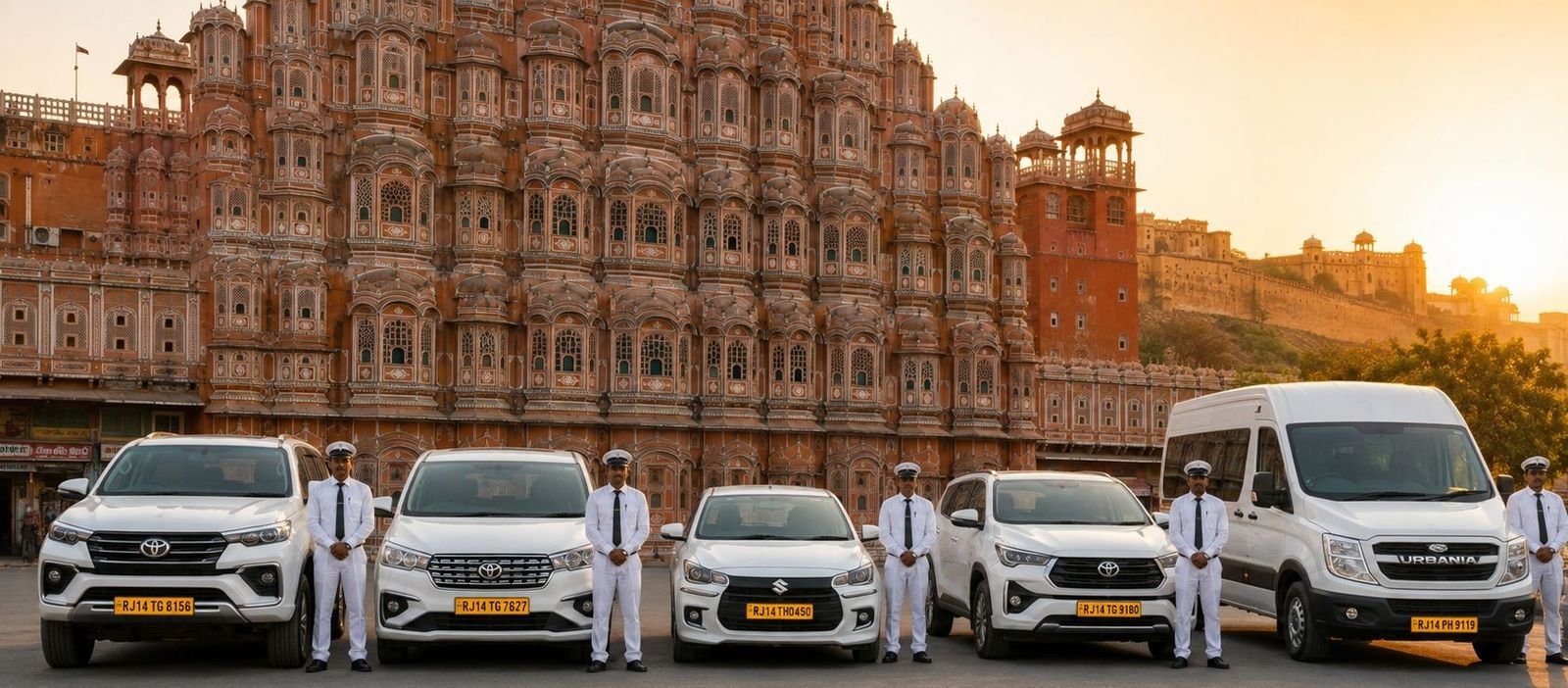
Discover Jaipur in a Single Day: The Pink City's Best Forts, Palaces and Hidden Gems
Jaipur, Rajasthan's flamingo-pink capital, is one of those cities that seems to have been purpose-built for travellers. Majestic forts crown its ridgelines, ornate palaces shimmer in the morning light, and bazaars overflow with block-printed textiles, blue pottery and the kind of street food that ruins you for anywhere else. The challenge is never what to see — it's how to see it without losing half your day to auto-rickshaw negotiations, unpredictable shared cabs or the logistical headache of stitching together public transport across a city that sprawls more than most visitors expect. A well-planned Jaipur city tour package with a private chauffeur solves every one of those problems at once, letting you move fluidly between the old walled city and the newer districts, timed perfectly around opening hours, crowd patterns and the punishing Rajasthan sun. Whether you're a first-time visitor squeezing Jaipur into a Golden Triangle itinerary or a returning traveller finally ready to go beyond the headline sites, this guide maps out the ideal single-day route — road realities, costs, hidden stops and all.
Route and Road Conditions for a Jaipur City Tour
A Jaipur city tour doesn't follow a single highway; instead, it loops through a mix of urban arterials, old city lanes and the hillside road up to Nahargarh Fort. Understanding the road texture helps you plan realistic timings.
The main arterials — Ajmer Road, Tonk Road, Amer Road (NH-48 extension) and Sikar Road — are wide, reasonably surfaced four-lane roads where travel is comfortable at most hours. The Amer Road, which carries you from the walled city toward Amber Fort approximately 11 km north of the city centre, is the most used tourist corridor. It is largely smooth, though traffic thickens considerably between 9 a.m. and 11 a.m. as tourist coaches converge on Amber. Your chauffeur can use parallel lanes and timed departures to avoid the worst of it.
The old walled city lanes around Johari Bazaar, Tripolia Bazaar and Chandpole are narrow, frequently congested with cycle-rickshaws, pedestrians and the occasional elephant — charming but genuinely slow. Plan for walking-only or very short car hops inside the walled city. Your driver will typically park at a sensible vantage point while you explore on foot.
The hillside road to Nahargarh Fort winds steeply up the Aravalli ridge on the western edge of the city. The surface is patchy in spots, with tight bends and no central barrier in sections. It is perfectly navigable in any vehicle in the fleet, though it rewards an experienced driver — precisely the advantage of a chauffeur service over an unfamiliar self-drive rental.
The road between Amber Fort and Jaigarh Fort is a short climb of roughly 2 km on a narrow hill track that connects the two forts. Most vehicles can manage it, but confirm with your chauffeur before attempting it rather than taking the longer outer road.
Tolls on a Jaipur City Tour
Because this is a city sightseeing loop rather than an outstation highway trip, toll expenses are minimal to negligible. There are no significant toll plazas within the city proper. The Amer Road approach from central Jaipur does not pass through a toll barrier.
If your itinerary is extended to include a pickup or drop from Jaipur International Airport (Sanganer), the route from the airport into the city may pass through local road levies, but these are approximately Rs 30–60 in total — hardly a meaningful budget item. For any route that begins or ends outside Jaipur — say, arriving from Delhi on NH-48 or departing toward Ajmer — toll costs become relevant for that intercity leg. If you're combining this city tour with a wider Rajasthan tour package, your Ruia Travels booking executive will give you a consolidated toll estimate upfront.
Fuel Stops During a Jaipur City Tour
For a city sightseeing loop, fuel availability is never a concern — Jaipur is one of the better-served cities in Rajasthan for fuel infrastructure. There are Indian Oil, BPCL and HP petrol pumps distributed across all major arterials: Ajmer Road, Tonk Road, Sirsi Road and the Amer Road corridor all have multiple options within every 3–5 km stretch.
Your Ruia Travels chauffeur will have the vehicle fully fuelled before the tour begins, which is standard operating practice. If the tour is extended or concludes with an outstation drop, the driver will refuel at a convenient point without meaningfully delaying your schedule. Notable reliable fuel stations for reference: the HP pump near Sindhi Camp bus stand, the BPCL station on Amer Road near Kukas, and the Indian Oil pump near Jagatpura on Tonk Road. In short, fuel is one logistical worry you can park entirely.
Best Departure Time for a One-Day Jaipur City Tour
Timing is arguably the single biggest factor in the quality of a Jaipur city tour, and it separates a polished experience from an exhausting scramble.
Ideal departure: 7:30 a.m. to 8:00 a.m.
Here's the reasoning. Amber Fort opens at 8:00 a.m. and the first hour — before the tour bus caravans arrive — delivers dramatically better photo conditions and a far more peaceful experience. Arriving at Amber by 8:15 a.m. means you're walking the fort's courtyards in golden morning light with a fraction of the later crowd. If you want the elephant ride to the fort's main gate, early morning is the only sane time to attempt it before queues grow unwieldy (though many visitors now prefer the walk or jeep for ethical and time reasons).
Starting at 7:30 a.m. also means you can work through the northern sites — Amber Fort, Jaigarh, Nahargarh — before the Rajasthan heat peaks. Between March and October especially, temperatures in Jaipur can climb past 35°C by midday and reach genuinely punishing levels by 2:00 p.m. Structure the day so outdoor and hilltop sites come in the cooler morning hours, and indoor or shaded sites — City Palace, Hawa Mahal's interior, the Albert Hall Museum — fill the early afternoon.
Lunch break: 1:00 p.m. to 2:30 p.m. Take this in the air-conditioned comfort of a Jaipur restaurant (your chauffeur will have local knowledge), then resume with the walled city bazaars and remaining cultural stops in the slightly cooler late afternoon.
Plan to finish at or near sunset at Nahargarh Fort or the Patrika Gate viewpoint — both offer spectacular views over the city as the sun drops behind the Aravallis, providing a natural and deeply satisfying endpoint to the day.
Places to Visit on a One-Day Jaipur City Tour
Below is a curated itinerary that balances the unmissable with the genuinely underrated. The sequence is designed to be logistically efficient — minimal backtracking — when covered with a private chauffeur.
1. Amber Fort (Amer Qila)
The undisputed centrepiece of any Jaipur city tour package. This 16th-century Rajput fort-palace complex sits on a hill overlooking Maota Lake and combines defensive military architecture with extraordinarily refined interior spaces — the Sheesh Mahal (Mirror Palace) alone, with its thousands of inlaid mirror chips, is worth the entire trip. Budget 90 to 120 minutes here minimum.
2. Jaigarh Fort
Connected to Amber by a long internal passageway, Jaigarh is often skipped by package tourists but is deeply rewarding. It houses the Jaivana cannon, reputedly the world's largest wheeled cannon, and offers commanding views over the surrounding hills. The fort has an austere, military-functional character that contrasts beautifully with Amber's palatial opulence. Allow 45–60 minutes.
3. Nahargarh Fort
Perched on the Aravalli ridge above the city's northwestern edge, Nahargarh ("Tiger Fort") is where savvy visitors come for panoramic views over the entire Pink City. The fort itself is partially in ruins but evocative, and the Padao restaurant inside serves decent food with a jaw-dropping backdrop. Excellent at both morning and sunset. Allow 45–60 minutes.
4. Hawa Mahal (Palace of Winds)
The five-storey pink sandstone façade with its 953 jharokha windows is Jaipur's most iconic image — but go inside, which most visitors don't. The interior galleries and rooftop terraces offer a fascinating perspective into how zenana (royal women's quarters) functioned as places of observation. Best photographed from the street-facing tea stall terrace across the road. Allow 45 minutes.
5. City Palace (Chandra Mahal)
Still the official residence of the Jaipur royal family, the City Palace complex includes several museums housing royal artefacts, textiles, weapons and the famous pair of silver urns — among the largest silver objects in the world, used to carry Ganges water for Maharaja Sawai Madho Singh II's 1901 London trip. Allow 60–75 minutes.
6. Jantar Mantar
Adjacent to the City Palace, this UNESCO World Heritage astronomical observatory built by Maharaja Jai Singh II in 1724 is genuinely strange and wonderful. The Samrat Yantra — a sundial nearly 27 metres high — can tell local time to within two seconds of accuracy. Allow 30–45 minutes with a guide for context (uninformed visits often miss the point entirely).
7. Albert Hall Museum
Jaipur's oldest museum, housed in a stunning Indo-Saracenic building in Ram Niwas Garden, holds an eclectic collection of Rajasthani folk art, carpets, pottery, jewellery and an Egyptian mummy. It's cooler indoors and crowds are lighter than the forts. A genuinely lovely hour, and criminally overlooked by itinerary templates that squeeze it out for more shopping time. Allow 45–60 minutes.
Hidden Gems Worth Including
Panna Meena ka Kund — a stunning 16th-century stepwell (baori) near Amber Fort, all geometric staircases and almost no tourists. Ten minutes from Amber Fort, and extraordinary for photography. Galtaji Temple (the Monkey Temple), tucked into a rocky gorge east of the city, is a working pilgrimage site with a natural spring-fed kund, peacocks and free-roaming langurs. Both can be woven in without significantly extending the day.
Patrika Gate
Built in 2016, this ornately painted gate at the entrance to Jawahar Circle is technically modern but architecturally spectacular — 10 arched gateways painted with scenes from Rajasthani culture. It photographs beautifully at golden hour and makes a vivid closing stop before dinner.
Approximate Fare for a Jaipur City Tour Package
Ruia Travels prices its Jaipur city tour packages on a per-kilometre basis with a local day package structure. A full-day city sightseeing tour (8 hours / approximately 80 km is a standard local day estimate for Jaipur city touring, though actual distance varies by itinerary) gives you the following approximate costs by vehicle:
- Maruti Dzire — at Rs 11/km, approximately Rs 880–1,100 for 80–100 km, suitable for 1–3 passengers
- Toyota Rumion — at Rs 14/km, approximately Rs 1,120–1,400 for 80–100 km, suitable for 4–5 passengers
- Innova Crysta — at Rs 18/km, approximately Rs 1,440–1,800 for 80–100 km, ideal for families or small groups wanting comfort
- Innova HyCross — at Rs 22/km, approximately Rs 1,760–2,200 for 80–100 km, the premium comfortable choice for discerning travellers
- Force Urbania — at Rs 38/km, approximately Rs 3,040–3,800 for 80–100 km, for large groups of up to 12–13 passengers
Note that local day packages typically include a minimum km guarantee and a defined time window (usually 8 hours). Additional kilometres or hours beyond the package limit are charged at the same per-km rate. Driver allowance, parking fees at monuments and entry tickets are not included in the vehicle fare and should be budgeted separately. Entry fees for Amber Fort, City Palace, Jantar Mantar and Hawa Mahal are payable individually; a composite Jaipur sightseeing ticket (available at entry counters) can cover multiple sites and typically offers a saving over individual tickets.
For tailored pricing and a formal quote for your travel dates, visit the Ruia Travels luxury car rental page or speak directly with our team.
Why a Chauffeur-Driven Car Beats Self-Drive or Bus for a Jaipur City Tour
The question of how to get around Jaipur deserves an honest answer, not just marketing. Here's why a private chauffeur-driven car is specifically the right tool for a single-day Jaipur city tour — and why the alternatives fall short.
Versus self-drive rental: Several companies offer self-drive cars in Jaipur. The problem isn't the car — it's the context. Navigating the walled city's lanes requires genuinely local knowledge to park sensibly, avoid restricted zones and find the vantage points that aren't on Google Maps. The hillside roads to Jaigarh and Nahargarh demand comfort with steep inclines and narrow bends. And fundamentally, self-drive means you're simultaneously tourist and driver — you cannot take in Amber Fort's exterior as you approach, adjust your camera for the Hawa Mahal shot from the road, or simply sit back and absorb the Pink City's extraordinary texture between stops. A chauffeur returns the city to you.
Versus bus or coach tours: Group bus tours impose a rigid schedule on a city that rewards spontaneity. Loved the Sheesh Mahal and want fifteen more minutes? Not possible. Want to stop at Panna Meena ka Kund on the way back from Amber? The bus doesn't go there. Tours also mean you move at the speed of the slowest participant and wait at every site for stragglers. A private car is your own timeline.
Versus auto-rickshaws or ride apps: App-based cabs work well for individual point-to-point trips but create friction across a multi-stop day — rebooking at each site, potential surge pricing, inconsistent driver knowledge and no continuity between stops. An auto-rickshaw, while charming for short walled-city hops, isn't appropriate for hillside routes and accumulates costs surprisingly quickly across a full day.
With Ruia Travels — operating since 1996 and with over three decades of Jaipur routing experience — your chauffeur isn't just a driver. He's a local navigator who knows where to park at Amber to skip the farthest walk, which gate at City Palace is currently operational, and exactly when the light hits Nahargarh's ramparts most beautifully. That institutional knowledge is the real product.
Frequently Asked Questions About Jaipur City Tour Packages
How many places can realistically be covered in a one-day Jaipur city tour?
With a 7:30 a.m. start and a private chauffeur-driven car, you can comfortably cover 6–8 major sites in a single day — typically Amber Fort, Jaigarh, Nahargarh, Hawa Mahal, City Palace, Jantar Mantar, and either Albert Hall Museum or a bazaar walk, with room for one or two hidden-gem stops like Panna Meena ka Kund. Trying to add more than 8–9 stops results in rushed visits rather than meaningful experiences. Quality over quantity is the right philosophy.
What is the best season to take a Jaipur city tour?
October to March is the peak and most comfortable season, with daytime temperatures ranging from approximately 15°C to 28°C. The winter months (December–January) are pleasantly cool, though evenings can dip to 7–8°C, so carry a layer. April to June is hot but perfectly manageable if you follow the early-start strategy outlined above and retreat to air-conditioned venues during the 1–3 p.m. window. The monsoon months (July–September) bring dramatic skies that make fort photography stunning, and crowds are thinner — the forts are at their greenest and most photogenic during this period.
Are entry tickets included in the Ruia Travels Jaipur city tour fare?
No — the vehicle fare covers transportation only. Entry fees to Amber Fort, City Palace, Jantar Mantar, Hawa Mahal, Nahargarh Fort and other monuments are paid directly by you at the site. A composite Jaipur sightseeing ticket, available at major fort entrances, bundles several sites and is usually better value than buying individually. Your chauffeur can advise on current pricing at each stop, though ticket rates are set by the Archaeological Survey of India and Rajasthan Tourism and may change seasonally.
Can Ruia Travels arrange a Jaipur city tour pick-up from my hotel or the airport?
Yes, absolutely. Ruia Travels offers hotel pick-up and drop anywhere within Jaipur city as standard, and airport transfers to and from Jaipur International Airport (JAI) can be combined with or appended to a city tour booking. Simply specify your hotel name and address when booking. If you're arriving from Delhi or Agra as part of a Golden Triangle itinerary, the city tour can be seamlessly linked to your intercity transfer — speak to the team to build a combined package.
Is a one-day Jaipur city tour enough, or should I plan for two days?
One well-structured day with a private chauffeur covers the essential Jaipur experience thoroughly. However, if your interests include deeper cultural immersion — block-print workshops in Sanganer, the textile collections at Anokhi Museum, the Galtaji temple complex, the gem-cutting quarters of Johari Bazaar — then two days gives you the unhurried experience the city genuinely deserves. Ruia Travels can structure either a single-day or multi-day local sightseeing package depending on your itinerary.
Book Your Jaipur City Tour with Ruia Travels
Jaipur rewards exactly the kind of seamless, flexible movement that only a private chauffeur-driven car provides. From the dawn-lit ramparts of Amber Fort to the panoramic blaze of the city at sunset from Nahargarh, the Pink City's greatest moments belong to the traveller who arrives at the right place at the right time — and that's precisely what Ruia Travels has been delivering since 1996. With a fleet ranging from the efficient Dzire to the spacious Force Urbania, transparent per-kilometre pricing, and drivers who know Jaipur's rhythms intimately, your day will be exactly as rich as the city promises.
Ready to plan your perfect Jaipur day? Book your Jaipur city tour package online in minutes, or contact the Ruia Travels team to speak with an expert who can tailor the itinerary, vehicle and timing to your exact travel dates and group size. The Pink City is waiting — and it looks best from the window of a car that knows where it's going.